For physicians
Keep licenses, DEA, board certification and malpractice coverage in one record. Reuse it for every application, renewal and assignment.
See how it works for physiciansPhysicians enter each credential once and decide who sees it. Agencies get a verified, current record by grant instead of a new packet for every assignment.
Keep licenses, DEA, board certification and malpractice coverage in one record. Reuse it for every application, renewal and assignment.
See how it works for physiciansRequest access to a physician's record. Every credential shows its source, verification date, verifier and expiry.
See how it works for agenciesA credential is collected once, verified with its provenance and then checked against each board's requirements. Select a station to see what happens at that step.
The physician uploads certificates and enters each credential once. Work history and disclosure answers are added as the physician's own statements. A physician who works with no organization can still use every station.
Two screens from the prototype, both with sample data. Each one opens a guided tour of the screen in the walkthrough.
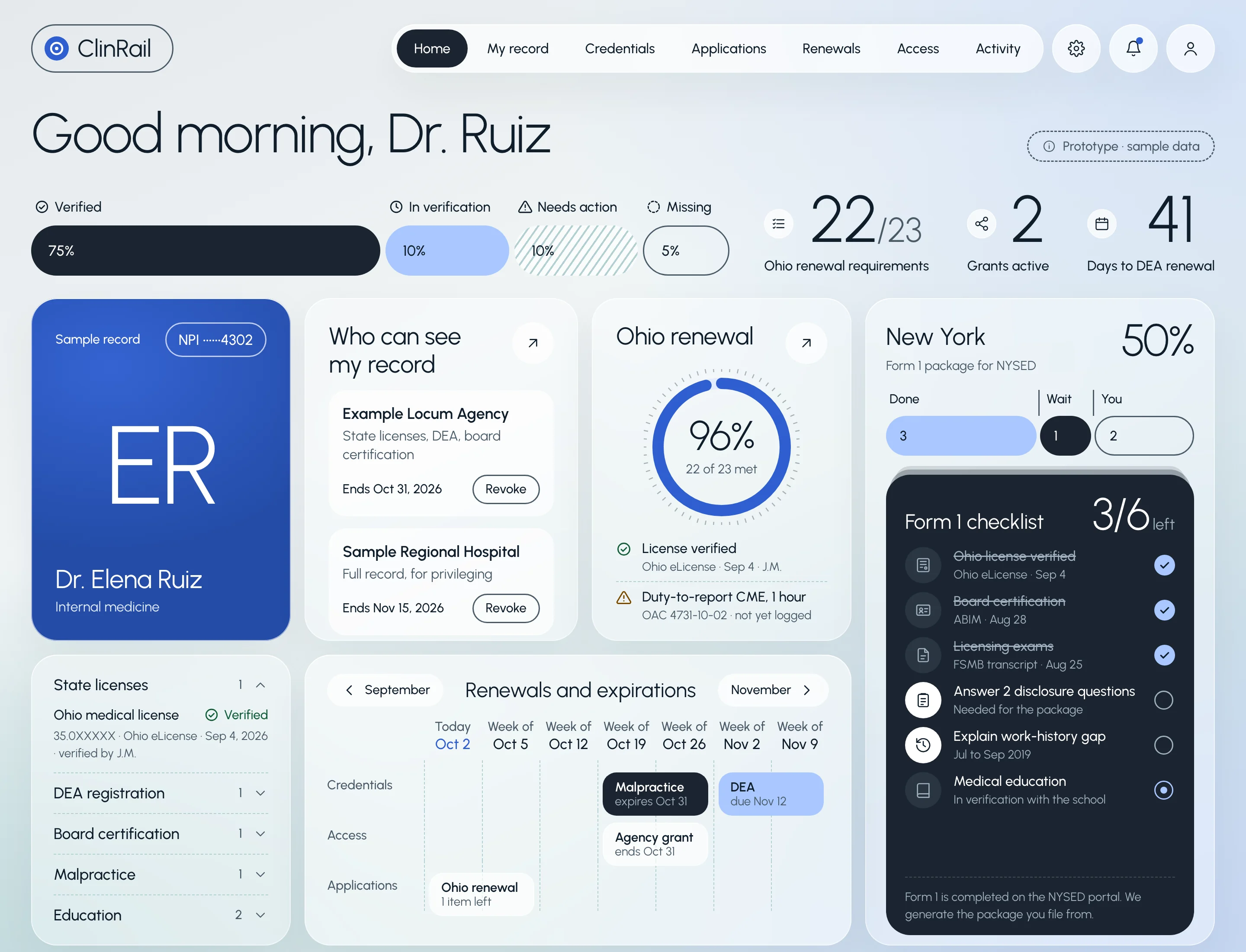
Dr. Ruiz sees the status of her record, who can see it, her Ohio renewal and the New York Form 1 checklist on one screen.
Take the physician tour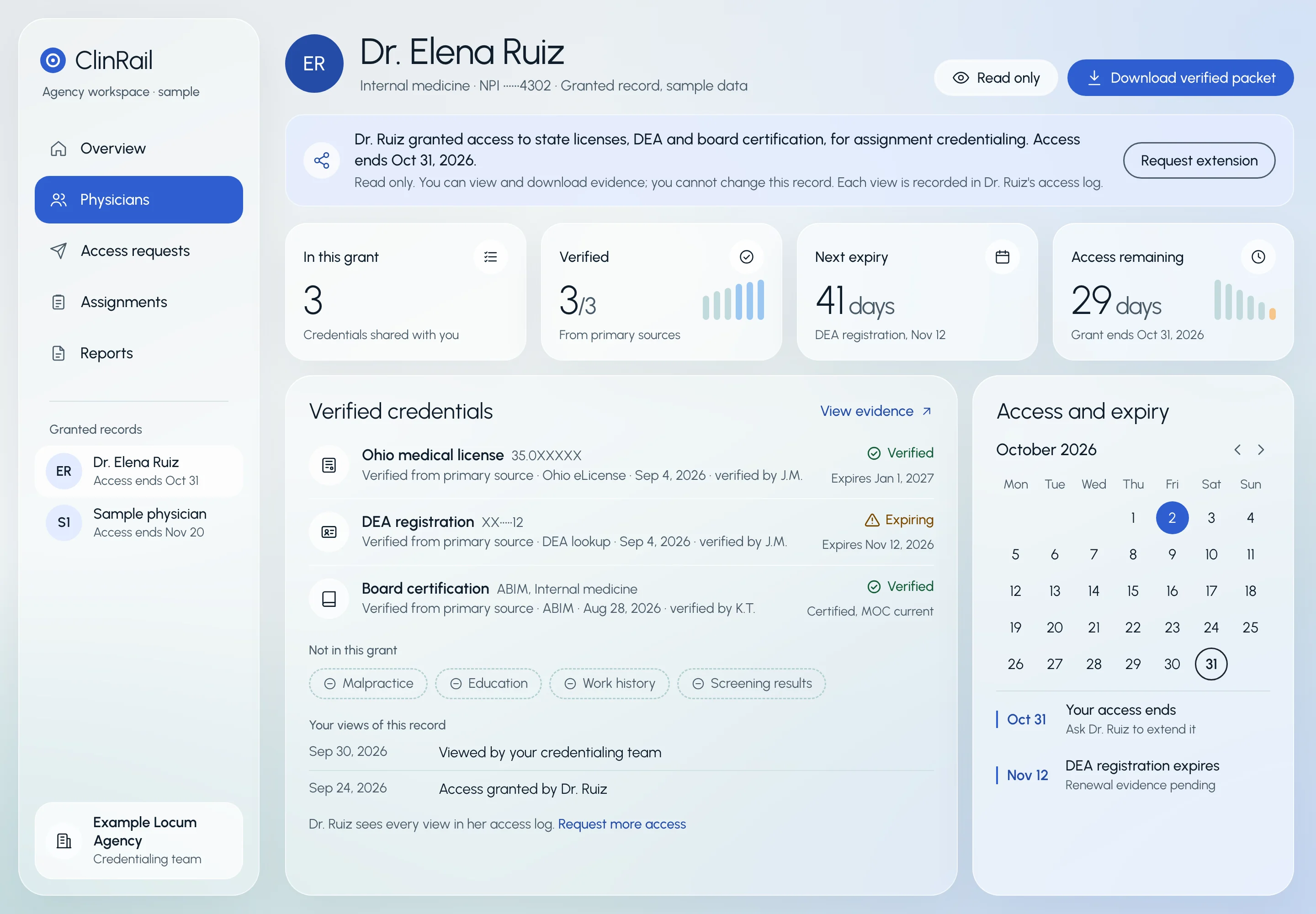
Example Locum Agency reads the same record under Dr. Ruiz's grant. Each credential shows where it was verified, and the date access ends stays in view.
Take the agency tourThe record belongs to the physician. Each credential is entered once and then used for applications, renewals and agency assignments. The physician decides which agencies can see it and for how long.
A license entered for a renewal is the same license an agency reads and a New York application uses. Nothing is typed twice.
A readiness count always comes with its list. Open items come first, and each one names the rule behind it.
License, DEA registration, board certification and malpractice coverage each have a date. The record shows what expires next.
The application package is built from the record. The physician files it on the board's portal.
An agency asks the physician for access. The physician grants it for a stated scope and period, and the agency reads the current record, read-only, until the grant ends or is revoked.
Name the credential types an assignment needs and the purpose. The physician decides what to share.
Every credential shows its source, verification date, verifier and expiry. The record is read-only.
Every grant has an end date. The physician can revoke it earlier, and access stops on the agency's next request.
Every view is written to the physician's access log. The agency sees its own views as well.
In the prototype, verification is performed by credentialing staff and recorded with its provenance. Two federal registries are checked on a schedule. Board rules are stored with the citation they come from.
A credentialing specialist checks each credential against its primary source. The source, method, date and the specialist's initials are recorded with the result. A correction is added as a new record.
Screening runs as a recurring, dated check. Each run stores a result for every physician, including a clear result. A partial name match goes to a person for review.
Each board requirement is stored with the statute or rule it comes from, its URL and its effective date. A rule without a primary citation is never added.
The record keeps verified facts, the evidence behind them and the physician's own statements separate, so each one shows where it came from.
State licenses, DEA registration, board certification, malpractice coverage, medical education and graduate medical training. Each verification record is attached to a credential.
Certificates, forms and captured source pages. Each file is checked for integrity, and one document can support more than one credential.
Work history, hospital affiliations and disclosure answers. A correction adds a new statement, and the earlier one stays in the history.
The prototype is built for physicians first, with two state boards and the credentials those boards and agencies ask for.
Physicians own the record, and agencies read it only under a grant the physician issues. Credentialing specialists record each verification in the staff console. Administrators manage accounts and configuration, and they have no access to clinical data.
This is a prototype with sample data. Nothing on this site verifies a credential, contacts a board or checks a registry live.
Board portals stay with the physician: the prototype prepares packages, and the physician files them.
Write to us if you would like to examine the prototype for a physician group or a locum agency. We will take you through it with sample data.